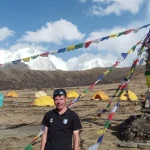
Himlung Expedition

Trip Facts

  • Destination Nepal
  • Activity Expedition
  • Duration 28 Days
  • Trip Difficulty challenging
  • Max. Altitude 7,126m / 23,380ft
  • Best Time April–May (Spring) and September–November (Autumn)
  • Start and End Kathmandu - Kathmandu
  • Meals Breakfast / Lunch / Dinner
  • Accommodation 5 star hotel in Kathmandu & Tea house/Camping
  • Group Size 2 - 40

Introduction

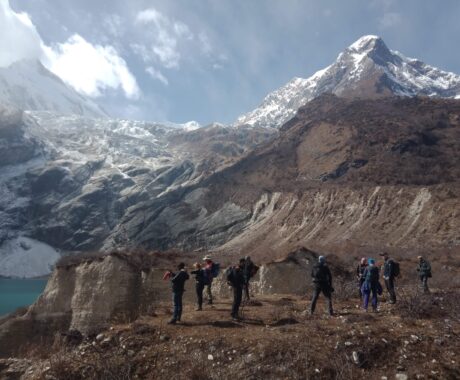
The Himlung Expedition is more than a mountain climb it’s a rare journey into Nepal’s most untouched wilderness. Standing at 7,126 meters (23,380 feet), Mt. Himlung is one of Nepal’s lesser-known 7,000-meter peaks, nestled in the remote Manaslu region near the Tibet border. What makes this expedition truly special is its perfect combination: a moderately challenging climb, authentic Tibetan Buddhist villages, and the genuine warmth of Nepal’s mountain people.

Unlike overcrowded trekking routes, the Himlung Expedition takes you through the hidden valleys of Nar and Phu remote settlements that have only recently opened to outsiders. This 28-day adventure offers experienced mountaineers and ambitious first-time climbers an achievable yet rewarding high-altitude experience with stunning cultural immersion.

What Awaits You: The Himlung Experience

The Mountain: A Moderate 7,000m Challenge

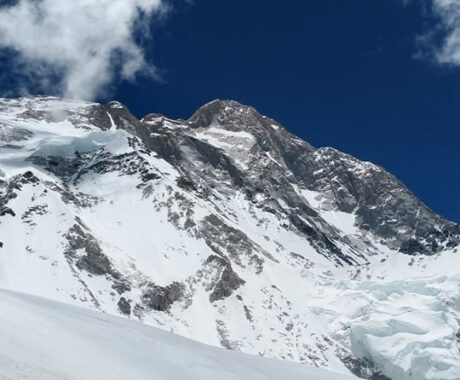
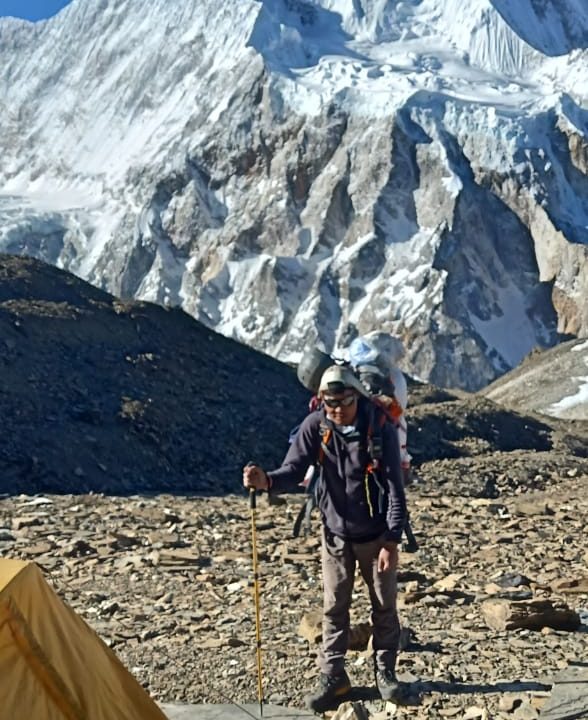
Himlung Himal stands in the remote northeastern corner of the Manaslu region, near Nepal’s border with Tibet. At 7,126 meters, it’s high enough to demand respect but moderate enough for climbers with good fitness and some mountaineering background.

What makes Himlung different:

  • Moderate technical difficulty: Not as demanding as 8,000m peaks, but steeper than beginner climbs
  • Less crowded: Far fewer climbers than Kilimanjaro or Elbrus
  • Remote location: You’ll trek through pristine valleys before reaching base camp
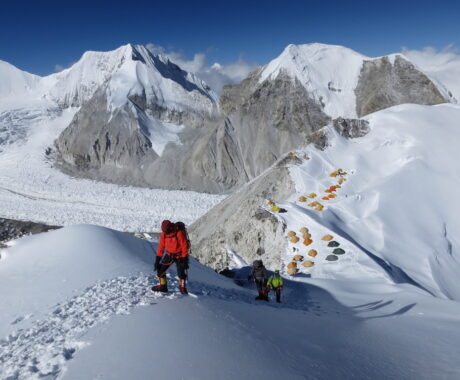
  • High-altitude camps: One base camp plus three additional climbing camps provide strategic acclimatization
  • Stunning views: Panoramic vistas of Nandadevi, Api Himal, and the Annapurna range

The climb involves technical sections with steep slopes, icy terrain, and the use of crampons and ropes. But with experienced guides, proper acclimatization, and mental determination, the summit is genuinely achievable.

The Hidden Valleys: Nar and Phu

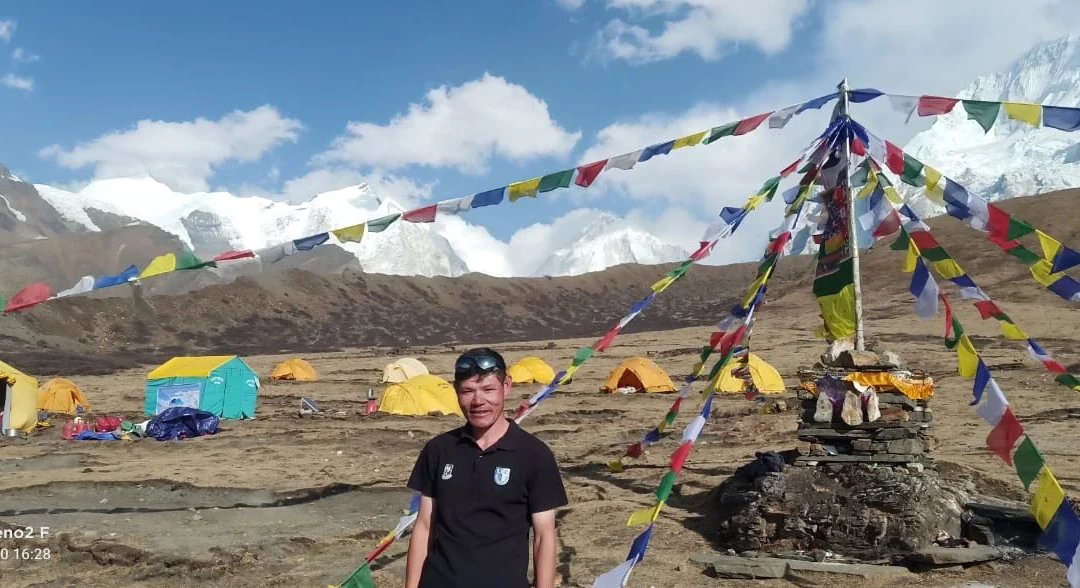
Before reaching base camp, you’ll trek through two of Nepal’s most culturally preserved villages. These aren’t tourist attractions-they’re real communities steeped in ancient Tibetan Buddhist traditions.

Phu Village:

  • Home to ancient monasteries and traditional stone houses
  • Surrounded by dramatic mountain landscapes and rugged terrain
  • Renowned for warm, genuine hospitality
  • The gateway to higher altitude trekking

Nar Village:

  • Picturesque settlement with stunning mountain views
  • Rich local traditions and authentic cultural experiences
  • Close-knit community life unchanged for centuries
  • A perfect place to learn about mountain living

Important: Both villages require special permits to protect the region from mass tourism. This ensures the area remains pristine and the local culture authentic.

Best Time to Climb Mt. Himlung

Spring (April – May)

Why it’s ideal:

  • Stable weather with mostly clear skies
  • Daytime temperatures warm enough for climbing
  • Wildflowers bloom along trails (stunning photos)
  • Strong jet stream less active (better summit weather)
  • Rhododendrons in full bloom in lower valleys

Challenges:

  • Can be crowded (more guided expeditions)
  • Some snow above 5,500m
  • Higher prices (more demand)

Best for: First-time climbers, photographers, those wanting cultural immersion in villages

Autumn (September – November)

Why it’s excellent:

  • Clearest skies of the year
  • Lower altitude snow (easier crampon work)
  • Fewer other expeditions (more solitude)
  • Dry trails and stable weather
  • Shorter approach means faster ascent

Challenges:

  • Colder at night
  • Some teams experience poor visibility October 15–25 (jet stream effects)
  • November expeditions may face extreme cold

Best for: Experienced climbers, those wanting solitude, summit-focused expeditions

Why Not Winter or Monsoon?

Winter (December – February):

  • Extreme cold (-20°C at camps)
  • Avalanche risk increases
  • Few local staff available
  • Minimal sunshine hours

Monsoon (June–August):

  • Heavy rains make trails dangerous
  • Visibility almost zero
  • High avalanche risk
  • Impossible for safe climbing

Verdict: April–May or September–November only. Spring is ideal for balanced challenge and experience; autumn for best summit conditions.

Real Challenges: Be Honest About Difficulty

The Himlung Expedition is rewarding but demanding. Here’s what to genuinely expect:

Altitude Challenges

  • Altitude sickness risk: 30–40% of climbers experience mild symptoms (headache, nausea, fatigue)
  • Sleep disruption: Expect 4–6 hours poor-quality sleep above 5,000m
  • Appetite loss: Many climbers struggle to eat above 6,000m
  • Extreme fatigue: The summit push is 12–16 hours of continuous climbing

Mitigation

  • Proper acclimatization (RP Adventures’ rotation schedule helps tremendously)
  • Guides monitor health daily and adapt plans
  • Descent reverses symptoms within hours

Physical Demands

  • Daily elevation gains: 500–1,200m during trekking phases
  • Pack weight: 8–10kg in your day pack
  • Climbing technique: You’ll learn rope work, crampon technique, and self-rescue
  • Mental fatigue: Extended periods at high altitude strain concentration

Reality: If you can climb Kilimanjaro or trek to Everest Base Camp, you can do this. It’s challenging but manageable with preparation.

Weather & Conditions

  • Temperature range: 15°C at base camp to -15°C at high camps
  • Wind: Can be intense; teams sometimes retreat for safety
  • Snow/ice: Technical sections require skill and focus
  • Exposure: Some sections have vertical drops; not for those afraid of heights

The 28-Day Itinerary Breakdown

Phase 1: Preparation in Kathmandu (Days 1–3)
Day 1: Arrival in Kathmandu
Day 2: Sightseeing in Kathmandu
Day 3: Leisure Day

Phase 2: Trek to Base Camp (Days 4–11)
Day 4: Drive to Besisahar (6–7 hrs)
Day 5: Drive to Koto (3–4 hrs)
Day 6: Trek to Meta
Day 7: Trek to Chyaku
Day 8: Trek to Kyang (~2,600m)
Day 9: Trek to Phu Gaon
Day 10: Acclimatization at Phu Gaon
Day 11: Trek to Himlung Base Camp (~4,700m)
What to expect: Progressive altitude gain, teahouse/lodge accommodation (twin-sharing), authentic trekking meals, and increasing immersion in mountain culture.

Phase 3: Acclimatization & Climbing Rotations (Days 12–19)
Day 12: Acclimatization at Base Camp
Days 13–19: Climbing rotations (Camp 1, 2, 3) & rest

Phase 4: Summit Push & Descent (Days 20–21)
Day 20: Summit attempt (7,126m)
Day 21: Descend to Base Camp

Phase 5: Trek Out & Return (Days 22–28)
Day 22: Base Camp → Phu Gaon
Day 23: Phu Gaon → Meta
Day 24: Meta → Koto
Day 25: Koto → Besisahar
Day 26: Drive to Kathmandu
Day 27: Leisure day in Kathmandu
Day 28: Final departure

Accommodation & Meals Throughout the Trek

In Kathmandu (Days 1, 27–28)

  • Hotel: Hotel Moonlight or similar
  • Standard: Private room with attached bathroom, hot water available
  • Meals: Breakfast in hotel; welcome dinner on Day 1; farewell dinner on Day 27

The pre-trek nights are restful preparation; the post-trek nights are celebrations. Enjoy them.

During Trekking Phase (Days 4–11, 22–26)

Accommodation: Teahouses and small lodges (family-run, twin-sharing rooms)

What to expect:

  • Simple, clean rooms with basic bedding
  • Most have attached toilets (squat or Western-style)
  • Limited hot water (thermos or bucket heated on stove)
  • Basic charging outlets (bring universal adapters)
  • Internet rarely available (good for disconnecting!)

Meals: Breakfast and dinner from lodge menu; lunch packed along the trail

Typical meals:

  • Breakfast: Porridge, toast, eggs, dal bhat (rice with lentils)
  • Lunch: Noodles, cheese sandwiches, instant soups, energy bars
  • Dinner: Dal bhat, curries, vegetables, simple meat dishes

Food quality: Clean, nutritious, and tasty. Teahouse food has improved dramatically; you won’t be eating unappetizing meals.

At High-Altitude Camps (Days 12–21)

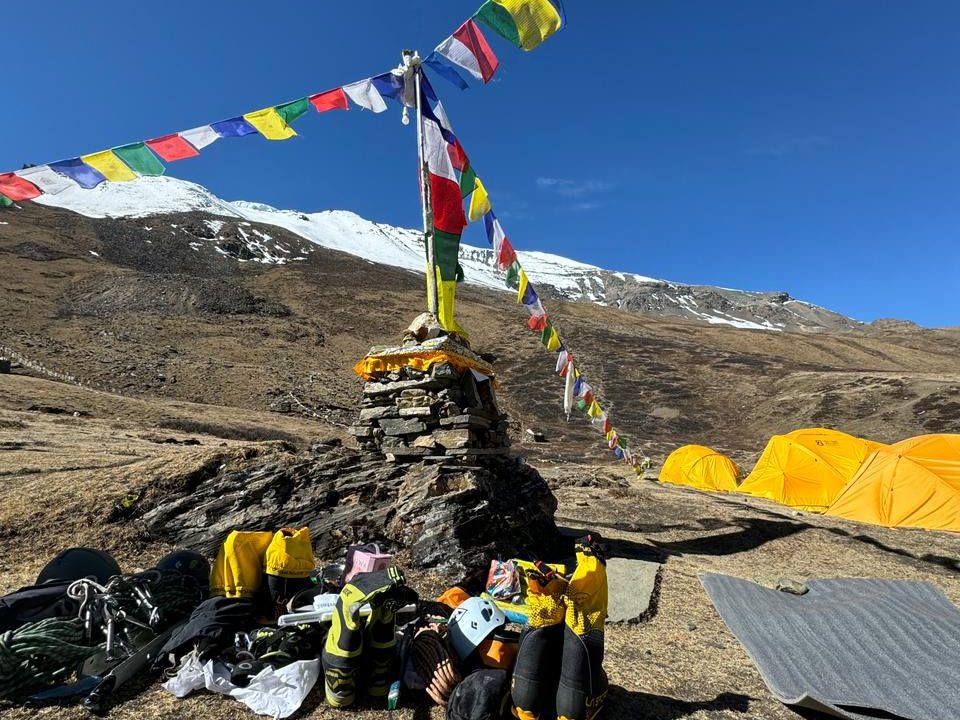
Accommodation: High-quality tents with sleeping pads

Setup:

  • Spacious 4-season tents with good ventilation
  • High-loft sleeping bags provided (rated to -15°C)
  • Ground insulation prevents cold from below

Meals: Cooked by expedition cook and Sherpas

Typical high-altitude diet:

  • Breakfast: Hot porridge, tea, high-calorie options (yak cheese, nuts)
  • Lunch: Trail mix, energy bars, chocolate, instant soups
  • Dinner: Simplified versions of lower-altitude meals (lighter, easier to digest)

Why meals matter at altitude:

  • You need 3,500–4,000 calories daily
  • Loss of appetite is normal; guides encourage small frequent meals
  • Hot meals improve morale and reduce hypothermia risk

Post-Expedition: What Happens After Summit

If You Summit

  • Celebration: The entire team celebrates together. Many expeditions have ceremonies or toasts.
  • Recovery: Your body recovers quickly once you descend below 5,000m. Most people feel normal within 24 hours.
  • Photos: RP Adventures provides summit certificate and photos. You’ll treasure these.
  • Fundraising option: Some climbers fundraise for causes; RP Adventures can help organize sponsorships for local charities.

If You Don’t Summit

Important: Turning back safely is not failure. It’s the right decision if:

  • Altitude sickness persists despite medication
  • Weather becomes dangerous
  • You’re physically exhausted
  • Your guide recommends descent

Reality: ~85% of well-prepared climbers summit Himlung. But 15% don’t—and that’s okay. You’ve still completed an incredible trek and cultural experience.

Post-trek: You’ll still receive the same celebration. The journey matters more than the peak.

Understanding Tipping Culture in Nepal Trekking

Tipping is an important part of Himalayan trekking culture. It’s not mandatory, but it’s genuinely appreciated and directly supports the people who make your expedition safe and memorable.

Is Tipping Expected While Trekking in Nepal?

Short answer: No, tipping is not mandatory or expected. It’s optional and appreciated.

Here’s the reality: RP Adventures and ethical trekking companies ensure all staff receive fair base wages. However, in Nepal’s mountain economy, tips represent additional income that significantly improves guides’ and porters’ livelihoods. Many use this money for children’s education, healthcare, or family support.

The honest perspective: Your guide and porter work long hours in challenging conditions. They navigate altitude, carry heavy loads, manage technical sections, and bear responsibility for your safety. A tip acknowledges their hard work and professionalism it’s an expression of gratitude, not an obligation.

How Much Should You Tip Guides and Porters?

Tipping amounts depend on several factors: trek difficulty, duration, group size, and personal satisfaction.

For Guides

Group Treks:

  • Budget: $8–15 USD per day (or 1,000–2,000 NPR)
  • 28-day Himlung: Total of $224–420 USD (or 27,000–54,000 NPR)
  • Example: A well-organized 28-day expedition with excellent guiding = $12–15/day

Private Treks:

  • Budget: $12–20 USD per day (or 1,500–2,500 NPR)
  • More personalized service justifies slightly higher tips
  • Example: 2 people with dedicated guide = $15–20/day

What influences the amount:

  • Guide’s experience level (Everest summitter vs. newer guide)
  • Service quality and attitude
  • Trek difficulty and risks managed
  • Your personal satisfaction

For Porters

Standard Rates:

  • Budget: $3–5 USD per day (or 400–700 NPR) per porter
  • For a 28-day trek: Total of $84–140 USD per porter (or 10,800–19,000 NPR)
  • Example: A strong, reliable porter with good attitude = $4–5/day

Reality check: Porters carry 20–25kg loads daily at high altitudes. A porter on the Himlung Expedition works extremely hard.

Realistic Examples for the Himlung Expedition

Scenario 1: Solo traveler, good experience

  • Guide: $12/day × 28 days = $336 USD
  • 2 Porters: $4/day × 28 days each = $224 USD (2 porters)
  • Total: ~$560 USD

Scenario 2: Couple with excellent service

  • Guide: $15/day × 28 days = $420 USD
  • 2 Porters: $5/day × 28 days each = $280 USD (2 porters)
  • Total: ~$700 USD

Scenario 3: Group of 4, challenging conditions, expert guide

  • Guide: $12/day × 28 days = $336 USD (split among 4 people = $84 each)
  • 4 Porters: $4/day × 28 days each = $448 USD (total; ~$112 per person)
  • Total per person: ~$196 USD

Tipping for Group vs Private Treks

Group Treks (What You Get)

  • Shared guide with 6–12 other climbers
  • One experienced guide manages the group
  • Porters shared across the group
  • Lower daily tipping rates are standard
  • Typical guide tip: $8–12/day
  • Typical porter tip: $3–4/day per porter

Why lower: Costs are distributed. Your guide’s salary is already reasonable because the company pays across multiple clients.

Private Treks (More Personalized)

  • Dedicated guide just for you (1–3 people)
  • Porters assigned specifically to your group
  • Customized pacing and flexibility
  • Higher daily tipping rates reflect personalized service
  • Typical guide tip: $15–20/day
  • Typical porter tip: $4–5/day per porter

Why higher: Your guide’s entire focus is your experience. They’ve forsaken other clients to serve you.

When and How to Give Tips

When to Tip

Best time: The last day or evening before departure

Why then:

  • You’ve completed the trek and can assess overall quality
  • It’s a natural moment for gratitude
  • Guides and porters expect tips at this time

Alternative: You can also tip in phases small amounts at difficult sections, larger tip at the end.

How to Tip Properly

Currency & Method:

  1. Nepali Rupees (NPR) – Preferred
    • Exchange at Kathmandu airport or ATMs
    • Current rate: ~132 NPR = 1 USD (approximate)
    • Small denominations are better (100, 500 NPR notes)
  2. US Dollars (USD) – Accepted
    • Crisp, clean bills (small denominations: $1, $5, $10)
    • Avoid large bills; guides may struggle to make change
    • No torn or marked bills

Presentation:

  • Use a clean envelope (provide yourself or ask hotel staff)
  • Hand privately to each person guides first, then porters
  • A brief thank-you is meaningful: “Thank you for taking care of me. You did an excellent job.”
  • Smile and make eye contact

Key etiquette:

  • Never tip in front of the group (it’s personal)
  • Give envelope with both hands (sign of respect in Nepali culture)
  • Don’t announce the amount

Why Tipping Matters: The Local Perspective

The Reality of Mountain Work

Your guide and porters aren’t wealthy. They work for companies like RP Adventures specifically because it offers stable employment and fair treatment. Here’s what their money goes toward:

Guides typically:

  • Support families of 4–6 people
  • Send children to school (tuition is costly)
  • Cover healthcare expenses in emergencies
  • Save for winter months when fewer treks operate
  • Invest in further training and certifications

Porters often:

  • Work to support aging parents or young siblings
  • Dream of secondary education for themselves or family
  • Earn $300–400/month base salary (very modest by global standards)
  • Face extreme physical demands joint problems, altitude effects, cold injuries

A $10 tip per day might seem small to you, but it can represent 10–15% of a porter’s monthly income.

What Good Tips Enable

When trekkers provide proper tips:

  • Children attend better schools
  • Families access medical care earlier
  • Guides upgrade safety equipment
  • Porters afford better boots and warm clothing
  • Communities invest in infrastructure

The broader picture: Ethical tipping strengthens mountain communities and encourages companies to hire and train local staff rather than relying on outside contractors.

Responsible Trekking with RP Adventures Pvt Ltd

RP Adventures is committed to ethical mountain trekking practices. Here’s why this matters for your Himlung Expedition:

Fair Wages & Ethical Practices

  • Fair Base Salaries: All guides and porters receive competitive wages (above the regional average)
    Insurance & Healthcare: All staff are covered for emergency medical expenses
    Equipment Standards: Guides and porters receive quality gear (boots, jackets, thermal clothing)
  • Safe Working Conditions:
    • Porter loads never exceed 25kg
    • No excessive working days without rest
    • Acclimatization schedules protect staff health
  • Training & Development: New guides receive mountaineering certification; senior staff lead expeditions
  • Transparent Practices: You’ll meet your entire team before departure and understand their roles

Why RP Adventures Stands Out

Unlike some budget operators:

  • No forced porter hiring: Your guide isn’t pressured to hire unqualified porters
  • Experienced leadership: Senior guides have summited 8,000m peaks
  • Sustainable tourism: The company works with local communities, not against them
  • No shortcuts on safety: Equipment, acclimatization, and health monitoring are never compromised

Your responsibility: When you tip ethically, you reinforce RP Adventures’ commitment to staff welfare.

Practical Tips for First-Time Trekkers

Before You Depart: Tipping Preparation

  1. Exchange money in Kathmandu
    • Visit an ATM or money changer at TIA airport
    • Get a mix of denominations (100, 500, 1,000 NPR notes)
    • Have about 50,000–100,000 NPR on hand for tips and expenses
  2. Prepare envelopes
    • Ask your hotel in Kathmandu for small envelopes
    • Or bring a few small envelopes from home
    • Number them (Guide, Porter 1, Porter 2, etc.)
  3. Know the team
    • RP Adventures sends team photos and bios pre-trek
    • Meet everyone on Day 1 in Kathmandu
    • Ask about their families, dreams, and previous summits

During the Trek: Relationship Building

Tipping isn’t just money – it’s respect. Build relationships by:

  • Learning team members’ names correctly
  • Asking about their families
  • Appreciating their effort on hard days
  • Following their guidance without hesitation
  • Sharing meals and conversations

This helps because:

  • Your team will work harder for you (safety, comfort)
  • The experience becomes truly personal
  • You’ll understand their perspective and challenges
  • You’ll tip confidently because you’ve earned trust together

Managing Altitude & Health

Your guides will monitor for altitude sickness. Help them help you:

  • Report headaches, nausea, or unusual fatigue immediately
  • Don’t push beyond your limits to impress anyone
  • Follow acclimatization protocols strictly
  • Drink 4–5 liters of water daily
  • Eat well, even when appetite drops

Remember: A guide who turns you back safely is better than one who risks your life for a summit. Good guides prioritize health over ego.

Tipping Summary: A Quick Reference Guide

For the Himlung Expedition (28 days):

RoleDaily RateTotal (28 days)Notes
Lead Guide$10–15 USD$280–420 USDOr 1,300–2,000 NPR/day
Porter (each)$3–5 USD$84–140 USDOr 400–700 NPR/day

Example total per person:

  • Solo: Guide $336 + 2 Porters $224 = ~$560 USD
  • Couple: Guide $420 + 2 Porters $280 = ~$700 USD (split = $350 each)
  • Group of 4: Shared guide $336 + 4 Porters $448 = ~$196 per person

How to tip:

  • Exchange NPR at Kathmandu airport or ATM
  • Use small denominations (100, 500, 1,000 NPR notes; $1, $5, $10 bills)
  • Prepare clean envelopes
  • On the last evening, give privately to each team member
  • A brief thank-you is meaningful

Why it matters:

  • Tips represent 10–20% of annual income for guides and porters
  • Money supports education, healthcare, and family welfare
  • Ethical tipping strengthens mountain communities
  • RP Adventures staff are already fairly paid; tips are genuine appreciation

Conclusion: Why Himlung Is Worth It

The Himlung Expedition is more than a mountain climb. It’s:

  • A genuine adventure in one of Earth’s most remote regions
  • A cultural immersion in authentic Tibetan Buddhist villages
  • A personal achievement reaching a 7,000-meter summit
  • A meaningful experience with guides and porters who become friends
  • A sustainable journey supporting local communities ethically

You’ll return home with:

  • Unforgettable summit views and mountain memories
  • Deeper appreciation for Nepal’s mountain culture
  • Confidence in your physical and mental strength
  • Real friendships with guides and Sherpas
  • Stories that matter and photos that inspire

The investment: $11,999 base cost + tips ($400–700) + travel insurance ($100–200) = approximately $12,500–12,900 total.

The return: A life-changing experience you’ll describe for decades.

Detailed Itinerary

  • Day 1: Arrival in Kathmandu (1,350m / 4,429ft)

    Upon arrival at Tribhuvan International Airport, you will be warmly welcomed by your expedition team and transferred to your hotel such as Hotel Moonlight or a similar standard property. After check-in, you’ll meet your climbing guide for a briefing about the expedition, route, and safety protocols. In the evening, enjoy a welcome dinner with authentic Nepalese cuisine.

    Altitude: 1,300m
    Meals: Dinner
    Accommodation: Hotel Moonlight or a similar
  • Day 2: Sightseeing in Kathmandu

    Explore key cultural sites in Kathmandu at your own pace. Rest and complete final gear checks while acclimatizing to the altitude.

    Altitude: 1,300m
    Meals: Breakfast / lunch / Dinner
    Accommodation: Hotel Moonlight or a similar
  • Day 3: Leisure Day

    Rest, shopping, or additional sightseeing. Use the day for mental preparation before the trek.

    Altitude: 1,300m
    Meals: Breakfast / lunch / Dinner
    Accommodation: Hotel Moonlight or a similar
  • Day 4: Drive to Besisahar (6–7 hrs)

    Drive from Kathmandu to Besisahar. The journey gradually leaves the city behind and enters hilly terrain, marking the start of your approach to the Manaslu region.

    Altitude: 760m
    Meals: Breakfast / lunch / Dinner
    Accommodation: Teahouse
  • Day 5: Drive to Koto (3–4 hrs)

    Continue driving to Koto. The road becomes more rugged as you move deeper into the mountains, reaching the last major road-access point.

    Altitude: 2,600m
    Meals: Breakfast / lunch / Dinner
    Accommodation: Teahouse
  • Day 6: Trek to Meta

    Begin trekking from Koto. The trail ascends through forested paths, marking your first day on foot with a steady gain in elevation.

    Altitude: 3,560m
    Meals: Breakfast / lunch / Dinner
    Accommodation: Teahouse
  • Day 7: Trek to Chyaku

    Continue trekking with a gradual climb. As you gain altitude, the landscape opens up and mountain views begin to improve.

    Altitude: 3,870m
    Meals: Breakfast / lunch / Dinner
    Accommodation: Teahouse
  • Day 8: Hike to Kyang (~2,600m)

    Trek to Kyang. The route continues ascending, with increasing exposure to higher-altitude terrain.

    Altitude: 2,600m
    Meals: Breakfast / lunch / Dinner
    Accommodation: Teahouse
  • Day 9: Trek to Phu Gaon

    Trek to Phu Gaon. You arrive at a remote village with a distinct mountain setting.

    Altitude: 4,080m
    Meals: Breakfast / lunch / Dinner
    Accommodation: Teahouse
  • Day 10: Acclimatization at Phu Gaon

    Rest and explore the village surroundings. This day helps your body adjust to altitude before continuing higher.

    Altitude: 4,080m
    Meals: Breakfast / lunch / Dinner
    Accommodation: Teahouse
  • Day 11: Trek to Himlung Base Camp (~4,700m)

    Trek to Himlung Himal Base Camp. The trail climbs steadily to base camp, where the climbing phase begins.

    Altitude: 4,700m
    Meals: Breakfast / lunch / Dinner
    Accommodation: Teahouse
  • Day 12: Acclimatization at Base Camp

    Settle in at base camp and allow your body to adapt to the altitude. Meet the full team and prepare equipment for climbing.

    Altitude: 4,700m
    Meals: Breakfast / lunch / Dinner
    Accommodation: Camping
  • Days 13–19: Climbing Rotations (Camp 1, 2, 3) & Rest

    During this period, you will follow a structured rotation plan, moving between camps and returning for rest. These climbs gradually expose your body to higher altitudes, improving adaptation and readiness for the summit attempt.

    Altitude: 6,100m
    Meals: Breakfast / lunch / Dinner
    Accommodation: Camping
  • Day 20: Summit Attempt (7,126m)

    Begin the summit push early in the morning. The climb is long and demanding, requiring steady progress to reach the summit before descending safely.

    Altitude: 7,126m
    Meals: Breakfast / lunch / Dinner
    Accommodation: Camping
  • Day 21: Descend to Base Camp

    Descend back to base camp after the summit attempt. This marks the end of the climbing phase and allows time for rest and recovery.

    Altitude: 4,700m
    Meals: Breakfast / lunch / Dinner
    Accommodation: Teahouse / Lodge
  • Day 22: Decend from Base Camp to Phu Gaon

    Begin descending back to Phu Gaon, retracing the route through familiar terrain.

    Altitude: 4,080m
    Meals: Breakfast / lunch / Dinner
    Accommodation: Teahouse / Lodge
  • Day 23: Continue Decend from Phu Gaon to Meta

    Continue descending along the same trail, gradually losing altitude and returning to lower elevations.

    Altitude: 3,560m
    Meals: Breakfast / lunch / Dinner
    Accommodation: Teahouse / Lodge
  • Day 24: Meta → Koto

    Trek back to Koto, where the trekking section ends and road access resumes.

    Altitude: 2,600m
    Meals: Breakfast / lunch / Dinner
    Accommodation: Teahouse / Lodge
  • Day 25: Koto → Besisahar

    Drive down to Besisahar, following the same route used during the approach.

    Altitude: 760m
    Meals: Breakfast / lunch / Dinner
    Accommodation: Teahouse / Lodge
  • Day 26: Drive to Kathmandu

    Return to Kathmandu by road, completing the mountain journey.

    Altitude: 1300m
    Meals: Breakfast / lunch / Dinner
    Accommodation: Hotel Moonlight or a similar
  • Day 27: Leisure Day in Kathmandu

    A free day to rest, explore, or spend time in the city after completing the expedition.

    Altitude: 1300m
    Meals: Breakfast / lunch / Dinner
    Accommodation: Hotel Moonlight or a similar
  • Day 28: Final Departure

    Transfer to Tribhuvan International Airport for your onward departure.

    Altitude: 1300m
    Meals: Breakfast

What's included

  • Arrival & Departure: Airport Transfer-Airport/Hotel/Airport
  • Accommodation: 5 nights at a 4* Hotel in Kathmandu on bed & breakfast Basis-Double Room
  • Member's transportation: Kathmandu-Samagaun-Kathmandu
  • Transportation: All required equipment Transportation for all Members and Staffs
  • Permits: Manaslu permit, National Park & TIMS permit
  • Food & Lodging: 3 meals a day while trekking & at Basecamp for members & Staffs
  • Dinner: 1 Farewell Dinner at a tourist-standard restaurant in Kathmandu with Nepalese Staff
  • Oxygen: 2 oxygen bottles for each member and 1 oxygen bottle for each high-altitude Sherpa
  • Mask & Regulator: 1 Set of top Out mask for each member and high-altitude Sherpa
  • High Altitude Climbing Sherpa:1 Climbing Sherpa per member

What's not included

  • International airfare to and from Kathmandu.
  • Nepalese Visa Charges
  • Lunch & Dinner in Kathmandu
  • Extra night in Kathmandu: Extra nights’ accommodation in Kathmandu. In case of early arrival or late departure, early return from the expedition (due to any reason) than the scheduled itinerary.
  • Insurance: Travel and High-Altitude Insurance / Accident / Medical / emergency evacuation
  • Personal Expenses: Telephone, Internet, Laundry, any Alcoholic beverages, Personal equipment, and shopping
  • Sherpa summit Bonus: Mandatory Minimum USD 1,200
  • Tips: Please calculate some tips for Basecamp staffs and porters
  • The full set of Member's personal climbing equipment & clothing
  • Rescue Evacuation: Emergency rescue evacuation cost, if needed, and all other expenses of personal nature
  • Any other item not listed in the "Price Includes" section.

Trekking Gears

Clothing

  • Thermal layers (merino wool preferred)
  • Fleece jackets (2)
  • Down insulated jacket (critical above 5,000m)
  • Waterproof outer shell (jacket & pants)
  • Lightweight trekking pants (2)
  • Thermal underwear set
  • Wool socks (4–5 pairs)
  • Gloves & mittens
  • Wool hat & balaclava
  • Sunglasses & goggles (snow glare protection)
  • Gaiters

Mountaineering Gear

  • Climbing boots (broken in beforehand)
  • Crampons (12-point or better; consider renting from RP Adventures)
  • Ice axe (available for rent)
  • Helmet
  • Harness, carabiners, belay devices
  • Rope (provided by expedition company)
  • Trekking poles

Personal Health & Hygiene

  • High-SPF sunscreen (altitude = more UV)
  • Lip balm with SPF
  • Blister treatment kit
  • Pain relievers (ibuprofen, paracetamol)
  • Altitude sickness medication (consult your doctor—Diamox is common)
  • Digestive aids
  • First aid kit (plasters, antiseptic, bandages)
  • Toiletries (minimal—water is scarce at altitude)
  • Prescription medications (3-month supply)
  • Menstrual products if needed (limited availability above base camp)

Electronics & Documents

  • Passport
  • Travel insurance documents
  • Visas (if required)
  • Phone or camera (extra batteries; very cold drains power)
  • Power bank (solar preferred)
  • Headlamp (for early starts)
  • Backup documents (digital copies)

Optional but Recommended

  • Earplugs (shared tents, altitude breathing changes)
  • Sleep mask
  • Journal & pen
  • Photos from home (to share with team)
  • High-calorie snacks (chocolate, energy bars)
  • Entertainment for rest days

Weight limit: Pack light. Porters carry your main bag, but you'll carry a day pack with 8–10kg of essentials.
FAQs of Himlung Expedition

  • 1. Do I need prior mountaineering experience?

    Helpful but not essential. RP Adventures teaches climbing skills during acclimatization phases. You should be fit and comfortable at altitude, but technical expertise can be learned.
  • 2. What's the success rate?

    Approximately 85% of climbers reach the summit with RP Adventures. Higher success rates come from proper acclimatization, experienced guides, and realistic pacing.
  • 3. Can I do this alone, or should I join a group?

    Both are fine. Group: More social, shared costs, established departure dates Private: Full personalization, private guide attention, flexible timing RP Adventures runs both. Groups are typically 6–8 people.
  • 4. What if I get altitude sickness?

    Guides monitor health daily. Descent (even partial) reverses symptoms within hours. You won't be forced to continue. Safety is the only priority.
  • 5. Is travel insurance necessary?

    Absolutely. Your insurance must cover: High-altitude mountaineering (up to 7,126m) Emergency evacuation by helicopter Medical treatment in Nepal Standard travel insurance won't cover mountaineering. Buy a specialist high-altitude climbing policy.
  • 6. What's included in the price, and what costs extra?

    All accommodation, meals, guides, equipment, permits Extra (estimate): Mountaineering equipment rental: $200–400 Tips for guides/porters: $400–700 Personal insurance: $80–200 International flights: $600–2,000 (varies by origin) Visas: $150 (for many nationalities) Meals in Kathmandu beyond those provided: $100–200 Total realistic budget: $13,500–15,000
  • 7. How do I prepare physically?

    Three months before your climb, focus on 45 minutes of stair climbing or elliptical training four days a week, along with weight training for core and leg strength. Two months before, begin hiking with an 8–10 kg weighted pack, include long walks on varied terrain, and continue your cardiovascular training. One month before, slightly reduce intensity to avoid injury, while practicing climbing footwork, breathing techniques, and mental visualization of the summit.
  • 8. What's the weather really like?

    At base camp (4,700 m), temperatures in April–May range from about 5–15°C during the day and drop to around -5°C at night, while in September–November they stay between 5–10°C in the daytime and can fall to -10°C at night. At higher camps above 6,500 m, daytime temperatures range from -5 to +5°C, and nights can drop to -15 to -20°C, with wind chill making it feel as cold as -30°C. Be prepared for extreme cold, though experienced guides carefully manage exposure and safety.

Trip You May Like

You can explore the related trips and choose one among them. :)
Mt Lhotse Expedition

Mt Lhotse Expedition

53 Days Trip challenging
Mt. Manaslu Expedition

Mt. Manaslu Expedition

35 Days Trip challenging
Ama Dablam Expedition

Ama Dablam Expedition – 30 Days

35 Days Trip challenging
Pumori Expedition

Pumori Expedition – 33 Days

34 Days Trip moderate
Call us (whatsapp/viber) +977 9849988926, 9818008417

Planning a Trip?

Our travel experts who are working in this industry for more than a decade will help you. Consult to get started.
Rajan Neupane

My journey in tourism began in 2008 as a porter. Step by step, I grew into roles as an assistant guide and tour leader. Over the years, I have worked across cultural tours, trekking, mountaineering, hotel operations, and spiritual journeys. For more than five years now, I have been running my own tourism and spiritual travel business, turning experience into meaningful travel experiences for guests.


Our Affiliations

Sister Company